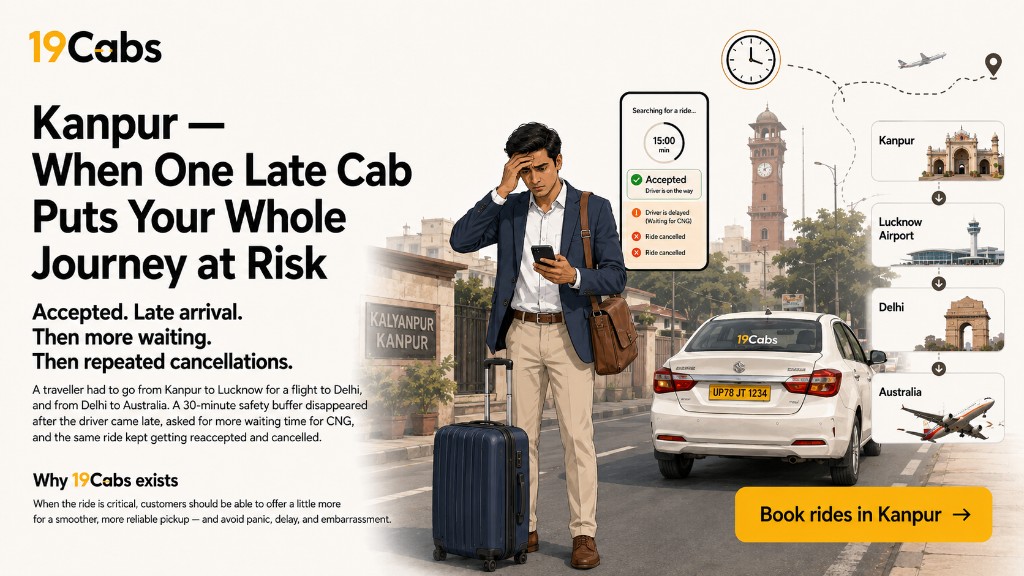
Call him Arjun — a Kanpur resident with one long journey stacked in front of him. Kanpur to Lucknow by cab. Lucknow to Delhi by flight. Then, about three hours later, Delhi to Australia. The plan looked careful on paper. The morning outside his gate did not.
Arjun’s problem that day was not the fare on the screen. He would have paid a little more without argument if the ride had simply been smooth and certain. What he needed was a captain who understood that this was not a casual market hop. This was a connection chain. Miss Lucknow, and Delhi slips. Miss Delhi, and Australia becomes a different kind of damage.
The half-hour that was supposed to keep him safe
He booked the Kanpur–Lucknow cab with a thirty-minute buffer built in on purpose. Not because he loved waiting. Because airport mornings punish optimism. Bags, traffic on the Kanpur–Lucknow corridor, check-in lines — he wanted the cushion.
The app accepted a ride. For a moment the plan still felt intact.
Then the driver arrived about fifteen minutes late. Arjun still tried to move fast. He loaded his luggage into the car, the kind of heavy, flight-bound bags that make every extra minute feel louder. That was when the driver said something that emptied the buffer in a single sentence: “Bhaiya, aadha ghanta aur wait karna hoga — gaadi mein CNG bharwani hai.”
Arjun had no useful option left. Standing outside his own home with bags already in a stranger’s boot, he cancelled. The embarrassment started there — not as a big scene yet, just the first crack in a morning that was supposed to look composed.
The same driver, again and again
He booked again.
The same driver picked up the request.
This time the driver did not want to cancel from his side. He pushed Arjun to cancel. Arjun cancelled from his own side and opened a fresh ride. The same driver came again. Again the pressure to cancel. It felt less like bad luck and more like a loop — as if the system kept handing the trip back to the same person, and as if a customer-side cancel somehow suited the other end better than an honest driver cancel.
Three or four rounds of this burned through roughly forty to forty-five minutes. The thirty-minute buffer was gone. He was already about fifteen minutes late against the plan he had trusted. Outside the house, what should have been a quiet departure had become a cab fight — bags, phone, cancellations, the same face returning on the screen. Embarrassing in a way that travel stories rarely admit out loud.
Parallel bookings, more waiting, and panic on the road
Arjun finally left that cab service behind and booked other apps in parallel. Even then, the next usable cab took about another twenty minutes to arrive.
By the time the wheels finally moved toward Lucknow, the math in his head had changed. He was no longer calculating a comfortable buffer. He was calculating miss risk — Lucknow check-in, the Delhi hop, the Australia sector after the three-hour gap. The whole road became a panic corridor. Every slow stretch felt personal. Every glance at the clock felt like an accusation.
He kept thinking the same bitter thought: he had never minded paying extra for a calmer morning. What he could not afford was this — uncertainty dressed up as an accepted ride.
Why 19Cabs exists
This is why 19Cabs exists.
Not so riders can play with prices for entertainment. So that when a trip is critical — Kanpur to Lucknow for a flight chain, a bank window, a hospital OPD, a school pickup, an interview — the customer can define that criticality inside the product. Raise the offered fare within safe limits. Give more captains a clear reason to take the ride seriously. Reduce the chance that “accepted” turns into CNG delays, cancel loops, and the same driver returning until your buffer is gone.
Arjun did not need a cheaper screenshot. He needed a smoother confirmation for a high-stakes morning — a little extra fare in exchange for far less embarrassment and far less risk of missing Lucknow, Delhi, and Australia in one collapsing chain.
On 19Cabs, that is the point of fare control: you still see the deal before you confirm, and when the ride matters, you can signal urgency so willing captains come closer to the trip you actually need. Read the full Why 19Cabs exists hub, try fare control, and see related stories from Delhi and Chennai.
If your next Kanpur run is an airport connection, not a casual errand, try 19Cabs in Kanpur. Raise the fare when the flight chain is tight. Confirm when a captain who is actually willing shows up. Ride when the agreement is already clear.