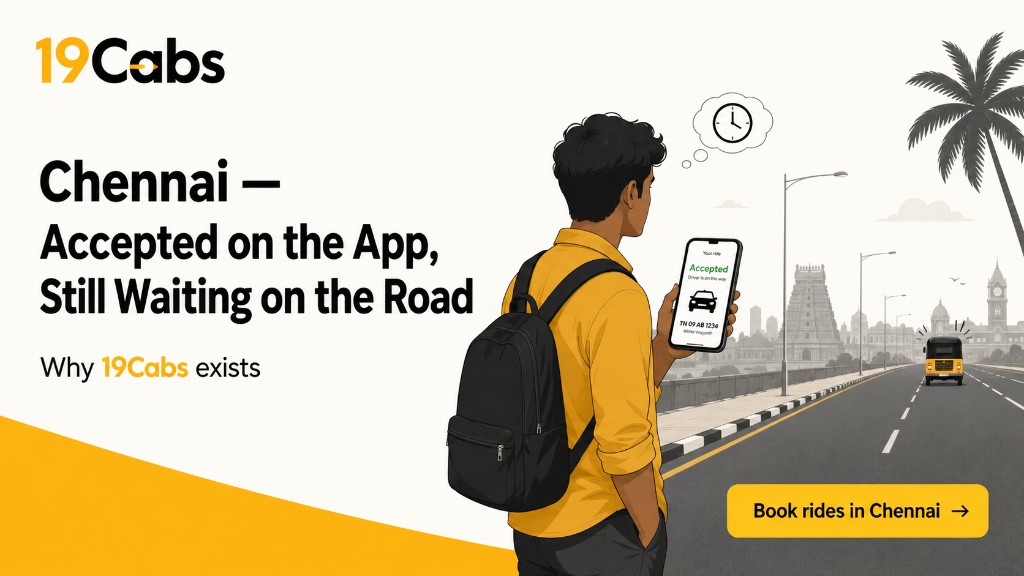
I was in Chennai for two weeks in December 2025 for a simple holiday — nothing work-related, nothing rushed on paper. I wanted filter coffee in the mornings, slow walks along Marina Beach, temple queues that stretched longer than I expected, and evenings drifting through T Nagar and Adyar without watching the clock. The city was warm and alive. Getting from one place to another, though, turned out to be harder than any map had prepared me for.
The booking that looked fine
Almost every day began the same way. I opened a popular ride app, dropped a pin where I was standing, typed where I needed to go, and chose whatever felt right for the moment — an auto for short hops, a bike taxi when traffic looked heavy, a car when I had bags or it was late. The estimate appeared. I tapped confirm. For a few seconds the screen felt reassuring, as if the city had already agreed to carry me.
Often the status flipped to accepted. A captain was assigned. An ETA started counting down. I would step toward the kerb, adjust my bag, and wait with the quiet confidence of someone who believed the machine.
Then the confidence thinned. The little car on the map would not move in any useful way. Sometimes it stayed far away for so long that the minutes stopped feeling like minutes. Sometimes it drifted a little, then froze, as if the trip had gone to sleep while I was still standing in the heat. Sometimes the app kept saying the ride was arriving long after dinner plans had already slipped, long after the buffer before a train or flight had already been eaten.
Then the phone call
When the phone finally rang, it was almost never to say, “I am two minutes away.”
It was closer to this: *Can you increase the fare? Then I will come.*
That sentence became the soundtrack of those two weeks. Sometimes no one accepted the ride at all, and I watched auto, car, and bike taxi requests circle through the same empty silence. Sometimes a ride was accepted and cancelled without explanation. Sometimes it was accepted, the call happened, the request for more money landed, and then nothing followed — no arrival, no honest cancellation, only me waiting on a Chennai roadside while the app still looked optimistic.
I saw the same loop near the airport corridors, outside railway stations, on short neighbourhood hops that should have been easy, on rainy evenings when an auto felt essential, and in the midday heat when a bike taxi looked clever on the screen and vanished in real life. Chennai did not feel short of vehicles. It felt short of a promise that the fare on the screen was the fare that would actually bring someone to me.
What those two weeks taught me
A tourist feels this kind of delay more loudly than a local might. The roads are unfamiliar. The language stretches. There is no cousin nearby who can “just call someone.” Every minute spent negotiating on the pavement is a minute stolen from the holiday you came to have. Locals, I later realised, often already know the workaround — call, bargain, switch apps, walk to a stand, pay a little extra so the evening does not collapse. I was learning that workaround the hard way, one failed pickup at a time.
Somewhere between the price the app showed and the price the street demanded, the ride stopped being a product and became an argument. The real cost was not only money. It was time, stress, and the quiet feeling that you were being tested for how desperate you looked while standing there with your phone in your hand.
Why 19Cabs exists
This is why 19Cabs exists.
Not because India needed one more logo on a phone screen. Because too many rides still break in the gap between what the app promises and what arrives on the road — accepted on the screen, still waiting on the kerb, then a phone call that turns the fare into a roadside negotiation.
That Chennai stretch made the problem personal. If the price on the screen is not the price that brings a captain, trust collapses. So 19Cabs was built around fare that stays in the open.
On 19Cabs you see an upfront estimate before you confirm. If you need a faster pickup, you can raise your offer within safe limits. If a driver feels the fare does not match the trip, they can ask for a fair increase inside the product instead of holding the ride hostage on a phone call. Both sides see the same deal before the wheels move. There is no silent “accept and stall,” and no roadside tax that appears only after you are already late. Read the full Why 19Cabs exists hub, try fare control, and the Delhi story of when timing matters more than the fare on the screen.
If you are in Chennai and you want auto, bike, or car without that waiting game, try 19Cabs in Chennai. See the fare first. Track the captain live. Ride when the agreement is already clear.