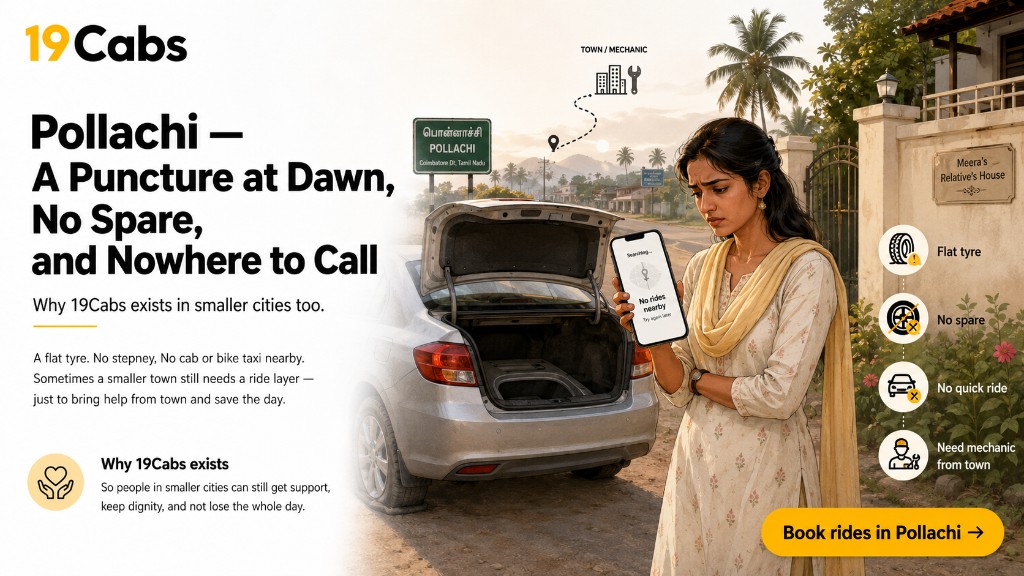
Call her Meera — visiting relatives on the edge of Pollachi, Tamil Nadu. Not a tourist checklist trip. A family stay. Night had already settled when she parked the personal car outside the house and went in for dinner and sleep. She did not know the tyre had given up in the dark.
Morning, and the day already tilting
She saw it in the morning light: a flat that had happened overnight. She opened the boot for the spare. There was no stepney. No quick swap. No ten-minute fix in the driveway.
The whole day’s plans started to lean at once — relatives to meet, a market run, an afternoon that had been mapped in ordinary family talk. Suddenly every kilometre between the house and town felt louder. Pollachi town was only a few kilometres away, close enough that a willing ride should have been ordinary. Far enough that walking with a mechanic’s bag, or stranded dignity, was not a joke.
Meera’s first thought was simple: if only she could book a cab — or even a bike taxi — into town, pick up a mechanic, and bring him back to the gate. Pay for the trip. Pay for the repair. Keep the day from falling apart without turning the morning into a public problem.
Then the empty screen
She opened the apps she knew from bigger cities. The map stayed quiet. No useful captains nearby. No confident estimate. No “arriving in eight minutes.” The kind of silence that big-city riders forget exists until they are standing beside a dead tyre in a smaller place.
Embarrassment arrived before the heat did. She would have to knock on local doors, ask neighbours, hope someone knew a mechanic who might come, hope that person was free, hope they were kind about a stranger’s morning failure. Help might come. Help might not. Support is not a schedule you can book when the town’s ride layer is missing.
She had no issue paying for a smoother fix. What she did not have was an option that let her stay composed.
Why smaller cities still need a ride layer
People say cabs belong to metros — Delhi, Bengaluru, Chennai, Hyderabad. Meera’s Pollachi morning asked a different question: if a smaller city cannot promise instant pickup every minute, can it still offer something — lower frequency, a slightly longer wait, a bike taxi that covers a few kilometres to fetch a mechanic, an auto that turns a stranded morning into a solvable one?
That “something” is not vanity coverage on a map. It is employment where earning options are thinner. A captain in a smaller town may not live on peak-hour urgency the way a metro driver does. The trips may be fewer. The waits may be longer. But the work is real — school runs, station drops, a puncture morning, a relative’s house on the edge of town. Remote and smaller places do not need the same density as a metro. They need a network that shows up often enough that people are not forced into embarrassment as their only plan.
Why 19Cabs exists
This is why 19Cabs exists in remote areas and smaller cities too — not only in the giants.
So that someone like Meera, stuck outside a relative’s home in Pollachi with a night puncture and no spare, has a chance to book support instead of begging the morning to be kind. So that captains in places with fewer earning options still have a platform for the trips that do exist. So that “a little later pickup” is still better than “no pickup at all.”
Urgency in a smaller town may look different from a Delhi bank-hour scramble or a Kanpur flight chain. The need is quieter and just as human: get help, keep dignity, finish the day. 19Cabs wants to be the side that tries to provide that support wherever it can reach — raise fare when you need a faster willing captain, or simply have a live option when the nearest mechanic is a few kilometres into town.
Read the full Why 19Cabs exists hub. See fare control for critical trips, and how the same product idea stretches from metros to towns like Pollachi. If you are in the area, try 19Cabs in Pollachi.